 It is a big day for change so how can I help but think of Ovid as we enjoy the spectacle of swearing in Barack Obama, our first NF personality president! (I am obsessed with the Myers-Briggs Type Indicator test, and am an Idealist INFJ. Mara is an ISTJ Guardian. Read More here) We were discussing these personality and change relataed issues on our long drive back from Denver for the Holidays and while visiting friends in Virginia. We also spoke at a conference at the Airlie Center on January 9th and as always enjoyed thinking about our farm goals and activities in a different light. With all the talk about economic crisis and the many comparisons with the Great Depression, I keep trying to think about our farm in a historical context. I think that the comparisons with the Depression of the Thirties are rather disingenuous, at this point. The level of poverty and desperation at that time is far beyond what anyone is experiencing today. Over 90% of the American workforce at that time was in agriculture, compared to less than 1% today. It seems that the economic crisis today means that money is no longer available for free with a home equity loan or an overpaid white collar service job. But all the talk of crisis makes me think of the peasants who have been the ones who weather the economic ups and downs of nations for centuries. I don't know if the U.S. has an equivalent to the peasant population of ancient Rome, but in many ways we have a similar misty-eyed reverence for our hard-scrabble, live-off-the-land ancestry. While studying Classics at the University of Colorado, I was often frustrated by the lack of context in which the scholars viewed both the Roman peasant and the Roman view of their peasants. We know very little about peasant life from the historical literature. Like today, the practical life of poverty was something to be escaped from and yet admired from a distance. As Mara and I talk about our farm's emphasis on gourmet and specialty vegetables, I can't help but notice that much of what we grow and sell are likely the foods that the peasant would have access to. Our vegetables are labor-intensive, but the home gardener would not be as likely to calculate the labor cost of her own produce. As we pour over the seed catalogs and cookbooks and cooking magazines at this cold time of year, I come to the conclusion that what is now gourmet and specialty is mostly a return to the peasant foods of our agricultural past. Only now, in the economic age of calculating the cost of our labor, we find that these foods are in fact worth so much more than they were originally given credit for. As one piece of evidence, I turn to Ovid's Metamorphoses. In book VIII, there is the one story, that of Baucis and Philemon, in the whole work that describes a meal in a peasant home. This is a rare glimpse in Latin poetry into the life of the poor Roman household. I started thinking about how this story would be translated in the style of a travel story in a modern day cooking magazine. Here is my attempt to describe the meal.
 "The old man pulled up chairs for the visitors and invited them to sit and rest, Baucis threw a coarse cloth over the seats and then adding bark and leaves to yesterday's fire, fanned and blew on it until it caught fire. She then took brush and twigs that were hanging from the roof and added them under her small bronze pot on the hearth. Philemon gathered some fresh vegetables from the well-irrigated garden and Baucis prepared them, stripping off the outer leaves. Meanwhile, Philemon lifted down a smoked pork back from the blackened rafters and cut off a small piece of the precious meat, adding it to the bubbling soup, and boiling it until it was tender. As they did this, the old couple talked welcomingly with their guests, to keep them from noticing the wait. They took a beechwood bowl, hanging from a nail by its curved handle, and filled it with warm water for the guests to refresh themselves. For the meal they set a cushion, stuffed with soft sedge grass on a couch made of willow wood, covering it with their finest linens, which even so, were old and cheap, matching the quality of the couch. The guests took their place for the meal. Baucis set the table and pushed a shard of old pot under one of the legs to keep it from shaking, then wiped the table off with stalks of fresh mint. The first course was semi-ripened brambleberries, wild cherries preserved in wine, endive, radishes some cheese, and fire-roasted eggs. These were served on clay dishes and wooden cups lined with beeswax. The soup, hot from the fire was next, and a young wine was passed around. Finally, there was dessert, nuts, figs and wrinkled dates and prunes, plus fragrant apples in wide baskets, and freshly harvested black grapes. In the middle of this was set a shining honeycomb, but above all, there was a cheerful atmosphere and a skilled and rich goodwill." Metamorphoses, Book VIII, lines 638-678
This scene is one of my favorite stories of all Latin poetry, a moment of elegy in a long epic poem, a grounding in reality. It is easy to imagine with all the travel and food shows and articles out today, a glowing description of this scene as a food writer journeys through the Italian countryside. I am still working on the big picture lesson from this, but meanwhile, even in the midst of economic crisis, it is good to have an example of living well with less. Yes, we can.
(For the 1 classicist out there who may read this, I am aware of the commentary and context of this story and the typical tone of the Latin poet idealizing the Golden Age. I have much more to say on that, but will not say it here. The translation takes some liberties.)


 They dig a pit, toss soil into a screen, shake the screen, look for artifacts, then do it until they've reached the depth they are shooting for.
 Here John Crock, the lead of the dig shows us where there are old plow lines, also lines that indicate past flood events. It was quite fascinating!
 Here you can see the flags running all the way down the 300' length of the hoophouse. What did they find? Nothing. Not a single thing. Not even an old horseshoe or nail! Sooooooo.
 We start building!!! Here Spencer is pounding in our first stake to set the perimeter of our house.
 Here we attempt to measure the distance. It was very windy and cold on this day. NOT FUN! Also hard to really measure accurately with all the wind flapping the measuring tape around.
 Ah! Perfectly square and ready to go!
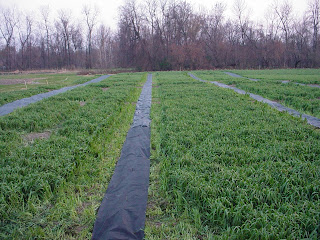
 This field belonged to Full Moon Farm this season, and before they left, they seeded a nice thick cover crop of oats. Thanks, Dave! I mowed swatches of it down to make the laying of Lumite down much easier.
  Here's our beloved Lumite the Landscape Fabric. This is laid before drilling the posts because once the hoophouse is all constructed, we never want to have to weed around each post!
 Once all the Lumite is in place, we start marking where each post will go. We created a plumb bob from a bunch of landscape tacks, and marked each post spot with a bent landscape tack.

 OK! All marked out and ready for action! We finished this project just as the sun was going down at 4:30 pm!!! Ah the north.....
 Next day, I loaded up the tractor and wagon with the posts while Spencer went to pick up the 2 man auger that we need to use to drill it in. It turned out that we needed to modify the bit that was sent to us to make the drilling possible, and so we had to take it to a metal shop and ask them to essentially rebuild it so that we could do the job. And, becuase they had the right tools, they accomplished this in all of 20 minutes, and then we were in business. Of course, the running around to see who could do this for us gobbled up 2 hours! So, instead of starting at 10 am, we finally really got going at 1pm.

 Here's the beast! It weighs about 40 or 50 pounds! We had to get a PTO extension (the red piece), and that shiny piece on the bottom is the "bit" we got made and used to connect the auger to the post.
 Linus drove the tractor forward most of the day. This was a HUGE help - so we didn't have to jump down, move the tractor, then jump up, drill, jump down, etc. Glad we didn't skimp on help!
 I would watch for our post markers to appear under me as Linus drove forward, then I'd yell, "Stop!". Sometimes I'd yell, "Back!", sometimes I'd yell, "Forward a little!" Our vocabulary was reduced to these words and when Spencer and I would drill, we'd use words like, "Ready!", "OK!", "Good!" Felt very cavemanlike, but it was so important to be clear - we're dealing with a big, heavy, unpredictable machine, here, people! Be clear.


